
Many hypnotherapists believe rapport is the golden key to successful hypnotic induction. While rapport enhances hypnotic susceptibility significantly, emerging research reveals it functions as one powerful factor among several. Understanding this nuanced relationship helps you develop more effective, evidence-based practices. This article examines the latest scientific findings on rapport’s role in hypnotic responsiveness, explores contrasting theoretical perspectives, and provides practical strategies for building therapeutic relationships that genuinely enhance client outcomes while maintaining ethical standards.
Table of Contents
- Key takeaways
- Understanding rapport’s impact on hypnotic susceptibility
- Empirical evidence: Ericksonian hypnosis and rapport-driven outcomes
- Contrasting theoretical views on rapport’s role in hypnotic responding
- Practical applications and ethical considerations in rapport building for hypnosis
- Advance your hypnotherapy skills with expert training
- Frequently asked questions
Key Takeaways
| Point | Details |
|---|---|
| Rapport boosts responsiveness | Rapport significantly enhances hypnotic susceptibility but is one factor among several shaping outcomes. |
| Ericksonian methods show large effects | A comprehensive meta analysis of randomized trials reports a standardized mean difference of 1.17 for Ericksonian hypnosis versus controls, indicating substantial clinical benefit across pain, depression, and irritable bowel syndrome. |
| Rapport skills are trainable | Training that targets expectations, attitudes, and relationship skills improves rapport quality and hypnotic responsiveness. |
| Theoretical views differ | Theoretical perspectives differ on whether rapport is essential and by what mechanisms it works. |
| Listening first builds trust | During initial consultations, spend seventy percent of the time listening and thirty percent explaining to build trust. |
Understanding rapport’s impact on hypnotic susceptibility
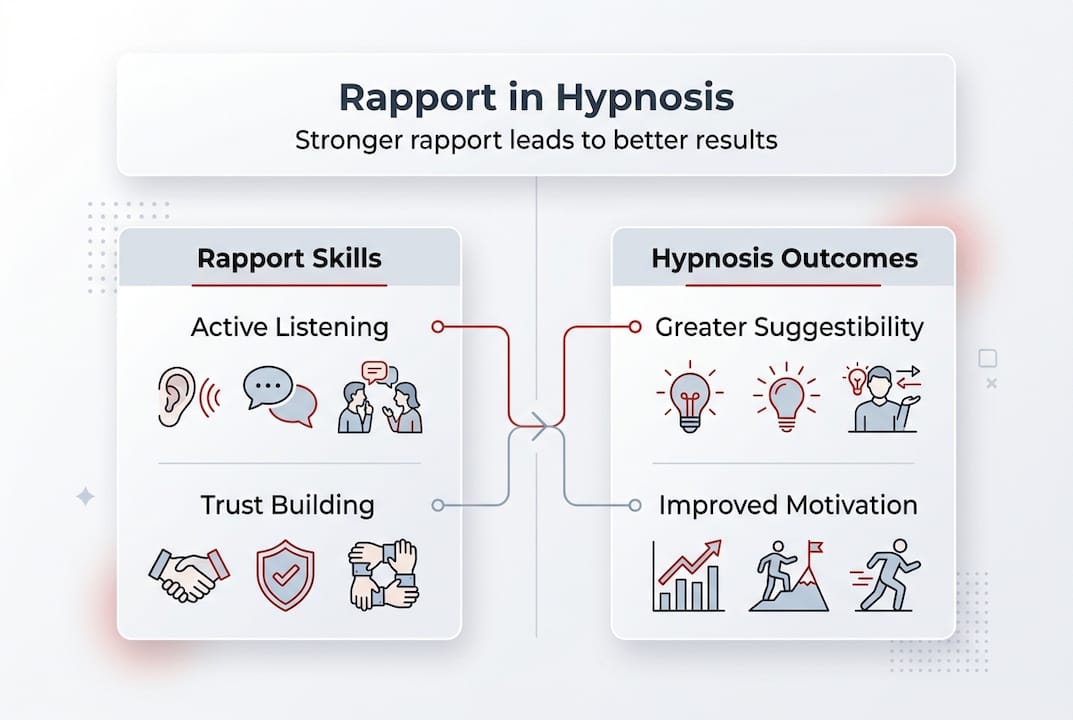
Rapport in hypnosis refers to the therapeutic alliance characterized by trust, mutual understanding, and emotional connection between practitioner and client. This relationship quality directly influences how readily clients respond to hypnotic suggestions and engage with the therapeutic process. Research demonstrates that rapport enhances hypnotic susceptibility through mechanisms involving expectation, motivation, and psychological safety.
Hypnotic susceptibility represents a multifactorial phenomenon influenced by client attitudes, prior beliefs about hypnosis, current motivation levels, and the quality of the therapeutic relationship. When you establish strong rapport, you create conditions where clients feel safe exploring altered states of consciousness. This psychological safety reduces resistance and increases willingness to follow suggestions. The relationship becomes a container supporting the hypnotic work rather than the work itself.
Social-cognitive research reveals that susceptibility isn’t fixed. Training interventions focusing on expectation modification, attitude adjustment, and relationship skills can measurably improve both rapport quality and hypnotic responsiveness. This means your ability to build rapport directly impacts treatment outcomes, making relationship skills as important as technical hypnosis knowledge.
Key skills for building effective rapport include:
- Demonstrating genuine curiosity about client experiences and perspectives
- Matching communication style to client preferences and comfort levels
- Validating emotions and concerns without judgment
- Establishing clear expectations while remaining flexible
- Monitoring nonverbal cues and adjusting accordingly
Pro Tip: During initial consultations, spend 70% of the time listening and only 30% explaining. This ratio builds trust faster than any technique demonstration.
Developing these essential hypnotherapy skills requires deliberate practice and feedback. Role-playing exercises, supervision sessions, and video review help you identify rapport-building strengths and growth areas. As you refine these abilities, you’ll notice clients responding more readily to inductions and maintaining deeper trance states. The investment in relationship skills pays dividends across every aspect of your practice, from initial engagement through successful treatment completion and building hypnotherapy confidence in your clinical work.
Empirical evidence: Ericksonian hypnosis and rapport-driven outcomes
Clinical trials provide compelling evidence for rapport’s practical importance in hypnotherapy outcomes. A comprehensive meta-analysis examining randomized controlled trials found that Ericksonian hypnotherapy shows large effects with a standardized mean difference of 1.17 compared to control conditions. This effect size indicates substantial clinical benefit across multiple applications including pain management, depression treatment, and irritable bowel syndrome.

The standardized mean difference of 1.17 represents an exceptionally large effect in psychological interventions. For context, effect sizes above 0.8 are considered large, meaning Ericksonian approaches significantly outperform this threshold. The rapport-intensive nature of Ericksonian hypnosis, characterized by permissive suggestions, indirect communication, and deep attunement to client responses, likely contributes substantially to these outcomes.
| Condition | Effect size (SMD) | Clinical significance |
|---|---|---|
| Chronic pain | 1.23 | Substantial reduction in pain intensity and interference |
| Depression | 1.15 | Meaningful symptom improvement comparable to CBT |
| Irritable bowel syndrome | 1.09 | Significant reduction in symptom severity and frequency |
| Anxiety disorders | 1.21 | Marked decrease in anxiety symptoms and avoidance |
Adjunctive hypnosis for pain management demonstrates particularly impressive results. Studies show patients receiving hypnosis alongside standard medical care report significantly lower pain levels, reduced medication requirements, and improved quality of life compared to those receiving medical care alone. The rapport established through hypnotic interaction appears to amplify pain relief mechanisms beyond suggestion effects alone.
These outcomes emerge from specific rapport-building practices:
- Creating individualized induction approaches matching client preferences
- Using permissive language that respects client autonomy
- Continuously calibrating suggestions based on observable responses
- Building trust through consistent, reliable therapeutic presence
- Validating client experiences throughout the hypnotic process
Pro Tip: Record your sessions (with permission) and review them specifically for rapport moments. Notice when clients visibly relax or deepen their engagement. These moments reveal your natural rapport strengths.
The evidence supports integrating advanced hypnotherapy methods that prioritize relationship quality alongside technical proficiency. Understanding body language in hypnosis enhances your ability to read client responses and adjust your approach in real time, strengthening rapport and improving outcomes. The data clearly indicates that rapport-focused approaches deliver measurable therapeutic benefits worth developing systematically.
Contrasting theoretical views on rapport’s role in hypnotic responding
Theoretical perspectives on hypnosis diverge significantly regarding rapport’s necessity and mechanisms. Traditional state theory, originating with early hypnosis pioneers, conceptualizes hypnosis as a distinct altered state of consciousness requiring rapport as the essential bridge between practitioner and client. This view treats rapport as the fundamental prerequisite enabling state induction and suggestion acceptance.
Socio-cognitive theory offers a contrasting framework. This perspective argues that traditional view considers rapport essential while socio-cognitive models treat it as one compliance factor among many. From this viewpoint, hypnotic responding emerges from role enactment, expectation fulfillment, and motivated compliance rather than a special state requiring rapport activation.
| Theoretical aspect | State theory perspective | Socio-cognitive perspective |
|---|---|---|
| Nature of hypnosis | Distinct altered consciousness state | Strategic social behavior and role-playing |
| Rapport’s role | Essential prerequisite for state induction | Facilitating factor increasing compliance |
| Mechanism | Rapport enables access to unconscious processes | Rapport shapes expectations and motivation |
| Clinical implication | Must establish rapport before attempting induction | Can work with minimal rapport if expectations are clear |
| Training focus | Develop rapport skills as primary competency | Balance rapport with suggestion crafting and expectation management |
Socio-cognitive models emphasize that hypnotic responding involves clients strategically enacting the hypnotic role based on their understanding of appropriate behavior. Rapport influences this process by increasing trust in the practitioner’s guidance and motivation to comply with suggestions. However, the theory suggests clients can respond hypnotically even with minimal rapport if expectations are sufficiently clear and motivation is high.
Emerging hybrid theories attempt to integrate these perspectives, acknowledging that:
- Phenomenological experiences during hypnosis feel genuinely altered to clients
- Social and cognitive factors substantially influence these experiences
- Rapport enhances outcomes through multiple pathways simultaneously
- Both state-like phenomena and strategic responding occur
Understanding these theoretical differences helps you develop flexible approaches. Some clients respond best to rapport-intensive Ericksonian methods. Others prefer more directive, technique-focused interventions requiring less relationship depth. Recognizing this variability prevents rigid adherence to single approaches and supports truly client-centered practice.
The theoretical landscape also informs how you conceptualize the role of hypnosis in self-improvement and understand the role of trust in hypnotherapy. Whether you lean toward state or socio-cognitive explanations, the practical reality remains consistent: stronger therapeutic relationships typically produce better outcomes, even if the mechanisms differ across theoretical frameworks.
Practical applications and ethical considerations in rapport building for hypnosis
Translating rapport theory into effective practice requires systematic skill development and ethical vigilance. Building therapeutic rapport follows a sequential process that deepens progressively throughout treatment.
- Establish initial connection through warm, professional greeting and genuine interest in the client’s story
- Demonstrate competence by explaining your approach clearly while acknowledging uncertainty where appropriate
- Create psychological safety through nonjudgmental responses and validation of client experiences
- Calibrate communication style by matching client preferences for directness, formality, and pacing
- Maintain consistency by following through on commitments and maintaining reliable therapeutic boundaries
- Deepen trust progressively by revealing appropriate self-disclosure and acknowledging the collaborative nature of treatment
Active listening forms the foundation of rapport building. This means focusing completely on client communication, reflecting content and emotion accurately, and asking clarifying questions that demonstrate genuine understanding. Clients recognize when you’re truly present versus mentally preparing your next intervention.
Matching and pacing techniques borrowed from neurolinguistic programming can enhance rapport when used authentically. Subtly mirroring body posture, speech tempo, and language patterns creates unconscious resonance. However, mechanical matching feels manipulative. The goal is genuine attunement, not mimicry.
Pro Tip: If you catch yourself thinking about what to say next while a client is speaking, you’ve lost rapport. Practice returning attention fully to their words, tone, and nonverbal communication.
Motivation management represents another crucial rapport element. Understanding what truly drives each client toward change allows you to frame suggestions in personally meaningful ways. Some clients respond to autonomy and self-determination. Others prefer structured guidance and expert direction. Tailoring your approach to motivational style strengthens engagement and outcomes.
Ethical considerations intensify when rapport is strong. Research indicates that rapport amplifies but is not sole driver of hypnotic responding, and ethical training is essential given heightened suggestibility. Strong rapport increases client openness to suggestions, creating responsibility to maintain clear boundaries and avoid exploiting trust.
Key ethical practices include:
- Obtaining informed consent that explains hypnosis realistically without overpromising
- Maintaining appropriate boundaries even when clients seek friendship or excessive contact
- Recognizing when rapport becomes dependence and supporting client autonomy
- Avoiding suggestions outside your scope of practice or client’s stated goals
- Seeking supervision when relationship dynamics become complex or uncomfortable
Ongoing training and peer consultation help you navigate the nuanced territory where strong rapport meets professional boundaries. Regular supervision provides space to examine relationship dynamics objectively and identify potential ethical concerns before they become problems.
Implementing these hypnotherapy practice tips systematically and developing robust hypnotherapy workflow for clients ensures rapport building enhances rather than complicates your therapeutic work. The investment in relationship skills, combined with ethical awareness, creates conditions for powerful, safe, and effective hypnotherapy practice.
Advance your hypnotherapy skills with expert training
Mastering rapport requires more than reading about techniques. Structured training provides the experiential learning, feedback, and supervision necessary for genuine skill development. If you’re ready to deepen your understanding of how therapeutic relationships amplify hypnotic effectiveness, specialized programs offer practical frameworks you can implement immediately.
Professional development focused on building hypnotherapy confidence through rapport mastery transforms your practice from technically competent to genuinely transformative. Comprehensive hypnosis training programs combine theoretical foundations with hands-on practice, helping you internalize relationship skills that feel natural rather than scripted. Learning to build effective hypnotherapy workflow for client sessions that prioritizes rapport alongside technique ensures every client interaction maximizes therapeutic potential while maintaining ethical standards.
Frequently asked questions
What exactly is rapport in the context of hypnosis?
Rapport refers to the quality of therapeutic alliance characterized by mutual trust, understanding, and emotional attunement between hypnotherapist and client. It creates psychological safety that facilitates openness to hypnotic suggestions and deeper engagement with the therapeutic process.
How does rapport specifically affect a client’s hypnotic responsiveness?
Rapport increases client willingness to follow suggestions, reduces resistance to trance induction, and enhances motivation to engage fully with hypnotic processes. Strong therapeutic relationships create expectancy effects and psychological safety that amplify suggestibility and deepen trance experiences.
Can rapport skills be trained or are they innate personality traits?
Rapport skills are absolutely trainable through deliberate practice, feedback, and experiential learning. Research demonstrates that social-cognitive training focusing on communication patterns, active listening, and attunement techniques measurably improves both rapport quality and client outcomes.
Is rapport the only factor determining hypnotic success?
No, rapport works alongside multiple factors including client attitudes toward hypnosis, prior beliefs and expectations, current motivation levels, and the technical quality of suggestions. While rapport significantly enhances outcomes, successful hypnotherapy requires addressing all these elements comprehensively.
What ethical considerations arise when building strong rapport in hypnosis?
Strong rapport increases client suggestibility and trust, creating responsibility to maintain clear professional boundaries, obtain genuine informed consent, avoid exploiting vulnerability, and ensure suggestions remain within ethical scope. Regular supervision helps navigate these complex relationship dynamics safely.