
Creating effective hypnosis scripts challenges most aspiring hypnotherapists. Over 60% of novice scripts fail due to preventable mistakes like unclear language and poor structure. This guide provides a clear, step-by-step method to write scripts that deepen trance, engage clients, and deliver measurable therapeutic outcomes.
Table of Contents
- Prerequisites And Tools Needed
- Script Structure And Components
- Language Patterns And Script Content
- Customization And Tailoring
- Common Mistakes And Troubleshooting
- Safety And Ethical Considerations
- Expected Results And Outcomes
- Alternative Approaches And Tradeoffs
- Explore Advanced Hypnosis Training And Resources
- How Do I Start Creating A Hypnosis Script For My Clients?
- What Are The Biggest Mistakes To Avoid When Writing Hypnosis Scripts?
- How Can I Ethically Ensure The Safety Of My Hypnosis Scripts?
- What Outcomes Can I Expect After Using Well-Crafted Hypnosis Scripts?
Key takeaways
| Point | Details |
|---|---|
| Structure scripts into four phases | Include induction, deepener, suggestion, and emergence for smooth trance progression. |
| Use positive, present-tense language | Employ sensory-rich descriptions tailored to individual client needs and goals. |
| Avoid common scripting errors | Eliminate negative wording, jargon, and ambiguity to improve trance depth by 40-70%. |
| Prioritize ethical compliance | Always obtain informed consent and protect client autonomy throughout the process. |
| Measure outcomes systematically | Track client feedback and observable changes to refine scripts over multiple sessions. |
Prerequisites and tools needed
Before you begin writing hypnosis scripts, establish a solid foundation. You need basic hypnosis knowledge, client assessment skills, and access to templates to improve script quality. Understanding hypnosis fundamentals helps you recognize how trance states form and what language patterns facilitate them.
Client goal assessment forms the cornerstone of effective scripting. Without knowing what your client wants to achieve, you cannot craft relevant suggestions. Interview clients thoroughly to identify their dominant sensory modality (visual, auditory, or kinesthetic) and specific therapeutic objectives.
Gather these essential tools:
- Script writing templates with pre-structured sections for induction, deepener, suggestion, and emergence phases
- Client intake worksheets that capture sensory preferences, language patterns, and therapeutic goals
- Reference guides on hypnotic language patterns including positive phrasing and NLP (Neuro-Linguistic Programming) well-formedness conditions
- Recording equipment to review your script delivery and identify areas for improvement
- Feedback forms to evaluate script effectiveness after each session
Familiarity with essential hypnotherapy practice tips accelerates your learning curve. Basic skills in evaluating script efficacy through client feedback help you iterate and improve continuously. Start with templates until you understand the rhythm and flow of effective scripts.
Script structure and components
Every successful hypnosis script follows a four-phase framework that ensures clearer trance induction and outcome alignment. This modular structure allows customization while maintaining therapeutic effectiveness. Understanding each phase helps you build scripts that guide clients smoothly from normal awareness into trance and back.
The four essential components are:
-
Induction phase: Create initial relaxation and focused attention. Use progressive muscle relaxation, breathing exercises, or visual imagery to shift the client’s awareness inward. This phase typically lasts 5-10 minutes and establishes rapport with the subconscious mind.
-
Deepener phase: Intensify the trance state to increase receptivity. Common techniques include counting down staircases, descending elevators, or imagining sinking into a comfortable surface. Deepeners prepare the mind to accept suggestions more readily.
-
Suggestion phase: Deliver personalized, positive affirmations aligned with therapeutic goals. This is where transformation occurs. Embed suggestions using present-tense language, sensory-rich imagery, and metaphors that resonate with your client’s experience.
-
Emergence phase: Safely return the client to full waking awareness. Count upward while reinforcing positive feelings and alertness. Never rush this phase as abrupt emergence can cause disorientation.
Modular construction enables you to swap components based on client needs. A client with anxiety might need a longer induction, while someone familiar with hypnosis might skip straight to a brief deepener. Following your hypnosis session workflow ensures consistency across all client interactions.
Each phase flows naturally into the next. Smooth transitions maintain trance depth and prevent the analytical mind from interrupting the process.
Language patterns and script content
Effective hypnosis scripts depend entirely on language precision. Always use positive affirmations in present tense to engage the subconscious mind directly. The subconscious processes literal meaning and struggles with negatives like “don’t” or “stop,” so frame everything as what you want the client to experience rather than what to avoid.
Include sensory-rich descriptions that deepen immersion and trance. Reference what clients see, hear, feel, taste, or smell in their imagined scenarios. The more vivid the sensory detail, the more real the experience becomes for the subconscious mind.
Key language principles:
- Frame all suggestions positively (“You feel calm and confident” not “You won’t feel anxious”)
- Use present tense as if changes are happening now (“You are releasing tension” not “You will release tension”)
- Employ sensory-specific vocabulary matching the client’s dominant modality
- Speak in second person (“you”) to create direct engagement
- Use permissive language (“allow yourself to…”) rather than commands
- Incorporate the client’s own words and phrases for authenticity
Negative or ambiguous phrasing reduces script efficacy significantly, appearing in 40-70% of ineffective scripts. Avoid jargon, technical terms, or ambiguous wording that confuses rather than clarifies. Simple language works best because the subconscious thinks in concrete images and sensations.

Apply NLP well-formedness conditions to strengthen suggestions. Each suggestion should be clear, stated in sensory-specific terms, initiated by the client (not imposed externally), and ecologically sound (no negative side effects). Review your hypnosis scripting language checklist before finalizing any script.
Pro Tip: Read your script aloud before using it with clients. If any phrase sounds awkward or unclear when spoken, rewrite it. Hypnosis is an auditory experience, so your script must flow naturally when heard.
Customization and tailoring
Generic scripts produce generic results. Aligning scripts to client-specific sensory experiences and goals significantly increases effectiveness. Personalization transforms a decent script into a powerful therapeutic tool.
Identify your client’s dominant sensory modality during the intake process. Visual clients respond to imagery and scenes. Auditory clients connect with sounds, rhythms, and internal dialogue. Kinesthetic clients need physical sensations and emotional feelings. Match your language to their preferred processing style.
Customization strategies:
- Replace generic imagery with specific scenes from the client’s life or aspirations
- Use the exact words and phrases your client uses to describe their goals
- Incorporate meaningful personal symbols, memories, or metaphors
- Adjust pacing and rhythm to match the client’s natural speaking tempo
- Modify suggestion intensity based on the client’s receptivity and trance depth
Modular script components make customizing client scripts efficient. Keep a library of inductions, deepeners, and suggestions organized by theme and sensory modality. Mix and match components to build personalized scripts quickly without starting from scratch each time.
Personalizing hypnosis scripts requires active listening during sessions. Notice which phrases cause visible relaxation or engagement. Track what imagery produces the strongest responses. Use this feedback to refine scripts between sessions.
Pro Tip: Maintain flexibility during live sessions. If you notice a client responding strongly to an unexpected phrase or image, lean into it. The best scripts adapt in real time to client feedback and non-verbal cues.
Common mistakes and troubleshooting
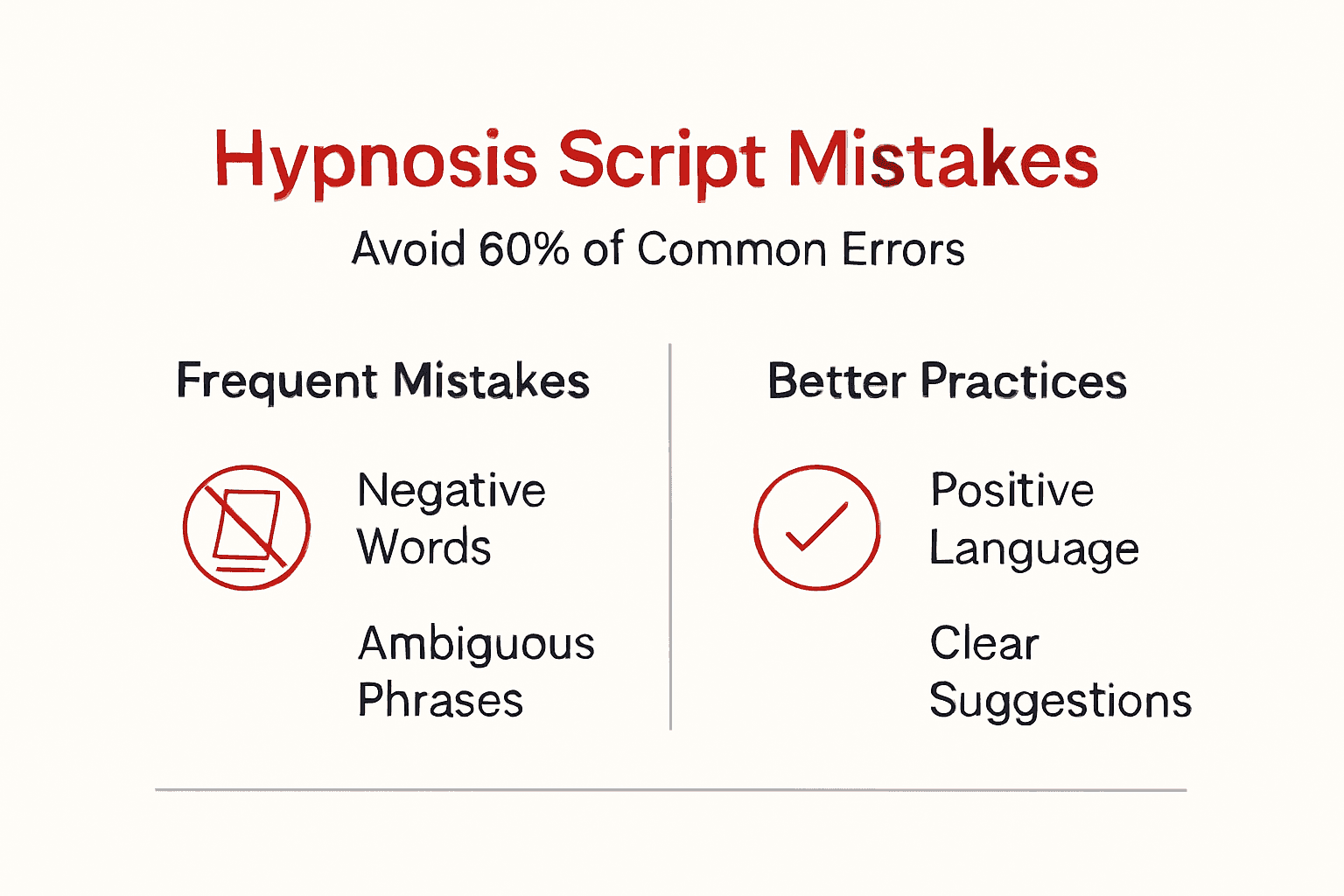
Over 60% of novice scripts fail due to preventable errors. Recognizing these mistakes early saves countless hours of frustration and protects your clients from ineffective sessions.
The most damaging errors:
-
Overcomplicated jargon: Using technical terms, complex metaphors, or abstract concepts confuses the subconscious mind. The subconscious thinks concretely and literally. Replace fancy language with simple, direct descriptions anyone could understand.
-
Lacking sensory detail: Vague suggestions like “feel better” provide no concrete imagery for the mind to grasp. Instead, describe exactly what “better” looks, sounds, and feels like using vivid sensory language.
-
Negative or ambiguous wording: Negative or ambiguous phrasing found in 40-70% of ineffective scripts disrupts trance and plants unwanted suggestions. The subconscious cannot process “don’t think about pain” without first thinking about pain.
-
Ignoring client context: Generic scripts feel impersonal and fail to address specific client needs. Without personalization, clients remain emotionally disconnected from suggestions.
-
Poor pacing: Rushing through phases or dragging them out breaks trance rhythm. Match your pacing to the client’s breathing and natural tempo.
Practical fixes:
- Simplify every complex sentence until a 10th grader could understand it
- Add specific sensory details to every suggestion (colors, textures, sounds, temperatures)
- Reframe all negative statements positively (“pain-free” becomes “comfortable and at ease”)
- Gather detailed client information and weave their language into your script
- Practice timing your script delivery to ensure smooth, unhurried pacing
“The most effective hypnosis scripts sound like a trusted friend guiding you through a pleasant daydream, not a textbook being read aloud.”
Address common hypnosis scripting errors before they become habits. Review common mistakes and fixes regularly to maintain quality standards across all your scripts.
Safety and ethical considerations
Ethical scripting protects both you and your clients. 94% of professional hypnotherapists require informed consent, highlighting how seriously the profession takes these responsibilities. Never compromise on ethics, regardless of client requests or pressure.
Core ethical principles:
- Always obtain informed consent before writing or delivering any script
- Explain the hypnosis process, what suggestions you will use, and what outcomes to expect
- Never include suggestions that override client free will or autonomy
- Avoid suggestions that could cause harm, create dependencies, or produce negative consequences
- Respect client boundaries and cultural sensitivities in all language choices
- Monitor client comfort and well-being throughout every session
- Maintain confidentiality regarding all client information and session content
Ecological validity ensures your suggestions create only positive ripple effects. Ask yourself: “If this suggestion works perfectly, could it cause any problems in other areas of the client’s life?” A suggestion to eliminate all anxiety might prevent healthy caution in dangerous situations. Balance therapeutic goals with real-world safety.
Use ethical language that empowers rather than manipulates. Suggestions should support client agency, not create dependency on you or the hypnosis process. Clients should feel more capable and self-sufficient after sessions, not less.
“Ethical hypnosis scripting respects the client as the ultimate authority over their own mind. We guide, suggest, and support, but never control or manipulate.”
Study hypnotherapy ethics and consent thoroughly before seeing clients. Ethics violations damage your reputation, harm clients, and potentially expose you to legal liability. When in doubt, consult with experienced practitioners or professional associations.
Expected results and outcomes
Set realistic expectations with clients from the start. Typical behavior change occurs over 3-6 hypnotherapy sessions using effective scripts. Immediate transformation happens rarely; sustainable change builds gradually through repeated reinforcement.
Measure progress through both qualitative feedback and observable outcomes. Ask clients to rate trance depth, comfort level, and how relevant the suggestions felt. Track behavioral or emotional changes aligned with therapeutic goals between sessions.
| Outcome Metric | Assessment Method | Typical Timeline |
|---|---|---|
| Trance depth | Client self-report scale (1-10) | Immediate post-session |
| Suggestion relevance | Client feedback on personalization | Immediate post-session |
| Behavioral change | Observable actions aligned with goals | 2-6 sessions |
| Emotional shift | Client reports of mood/feeling changes | 1-4 sessions |
| Goal achievement | Measurable outcome completion | 3-6 sessions |
Iterate and refine scripts based on results. If a client reports shallow trance, extend your induction or add a deeper relaxation deepener. If suggestions feel generic, gather more personalized details and incorporate client language more thoroughly.
Document what works and what doesn’t for each client. This data informs future script adjustments and helps you identify patterns across your practice. Track hypnotherapy client progress measurement systematically to demonstrate value and improve outcomes.
Some clients respond immediately while others need more time. Factors like motivation, expectation, rapport, and issue complexity all influence timeline. Communicate openly about progress and adjust your approach based on evidence.
Alternative approaches and tradeoffs
Full scripts provide structure and consistency, especially for beginners. However, conversational hypnosis offers flexibility and responsiveness for experienced practitioners. Understanding both approaches helps you choose the right method for each situation.
| Aspect | Scripted Hypnosis | Conversational Hypnosis |
|---|---|---|
| Structure | Fixed, pre-written | Fluid, adaptive |
| Consistency | High across sessions | Varies by session |
| Skill requirement | Beginner-friendly | Advanced proficiency needed |
| Personalization | Pre-planned customization | Real-time adaptation |
| Client rapport | May feel less personal | Often feels more natural |
| Outcome predictability | More consistent | More variable |
| Preparation time | Longer upfront | Minimal pre-session prep |
Scripted approaches work best when you need consistency, are building foundational skills, or working with complex issues requiring careful suggestion crafting. Scripts ensure you don’t accidentally omit crucial elements or use problematic language.
Conversational hypnosis shines when building deep rapport, responding to unexpected client reactions, or integrating hypnosis subtly into therapy dialogue. It requires advanced training and quick thinking to maintain trance while adapting suggestions on the fly.
Many practitioners blend both approaches. Start with a scripted induction and deepener for consistency, then shift to conversational suggestions tailored to real-time client responses. Return to a scripted emergence for safety and completeness.
Explore non-traditional hypnosis approaches as your skills develop. Experiment with different styles while maintaining ethical standards and client safety. Your ideal approach evolves with experience and client population.
Explore advanced hypnosis training and resources
Mastering hypnosis scripting requires continuous learning and practice. Advanced hypnosis trainings provide deeper techniques beyond basic script writing, including conversational hypnosis, advanced language patterns, and specialized applications for complex issues.
Confidence transforms good scripts into great therapeutic experiences. Discover how to build hypnotherapy confidence naturally through structured practice, peer feedback, and professional mentorship. Confident delivery amplifies script effectiveness regardless of the words on the page.
Integrate script writing into a comprehensive session framework. Learn strategies for building hypnotherapy workflow that seamlessly connects intake, script customization, delivery, and follow-up. Systematic workflows free mental energy to focus on client connection rather than logistics.
How do I start creating a hypnosis script for my clients?
Begin with thorough client assessment to understand their goals, sensory preferences, and specific concerns. Use essential hypnotherapy practice tips to guide your intake process. Start with proven templates structured into induction, deepener, suggestion, and emergence phases, then customize language to match your client’s needs. Apply positive, present-tense, sensory-rich phrasing throughout.
What are the biggest mistakes to avoid when writing hypnosis scripts?
Avoid complicated jargon, negative wording, and ambiguous language that confuses the subconscious mind. Common mistakes include negative language, jargon, and ignoring client specifics, which reduce effectiveness dramatically. Always tailor your script to individual client goals and dominant sensory modalities. Include vivid sensory details to deepen trance and enhance suggestion absorption. Review common hypnosis scripting errors and common scripting mistakes before finalizing any script.
How can I ethically ensure the safety of my hypnosis scripts?
Always obtain informed consent and clearly explain session goals, the hypnosis process, and expected outcomes before scripting. 94% of hypnotherapists require informed consent, emphasizing its ethical importance. Avoid suggestions that override client free will, create dependencies, or could cause unintended harm. Use empowering language that supports client autonomy and respects their values. Monitor client comfort throughout sessions and adjust immediately if they show distress. Study hypnotherapy ethics and consent principles regularly to maintain professional standards.
What outcomes can I expect after using well-crafted hypnosis scripts?
Behavioral change commonly occurs over 3-6 sessions using effective scripts and consistent application. Expect to observe emotional shifts, behavioral improvements, and progress toward stated therapeutic goals within this timeframe. Use client feedback on trance depth, suggestion relevance, and session comfort as immediate qualitative measures. Track observable outcomes aligned with client goals to measure hypnosis client progress objectively. Results vary based on issue complexity, client motivation, and rapport quality, so maintain realistic expectations while documenting progress systematically.